
Can You Upsize Your Tires?
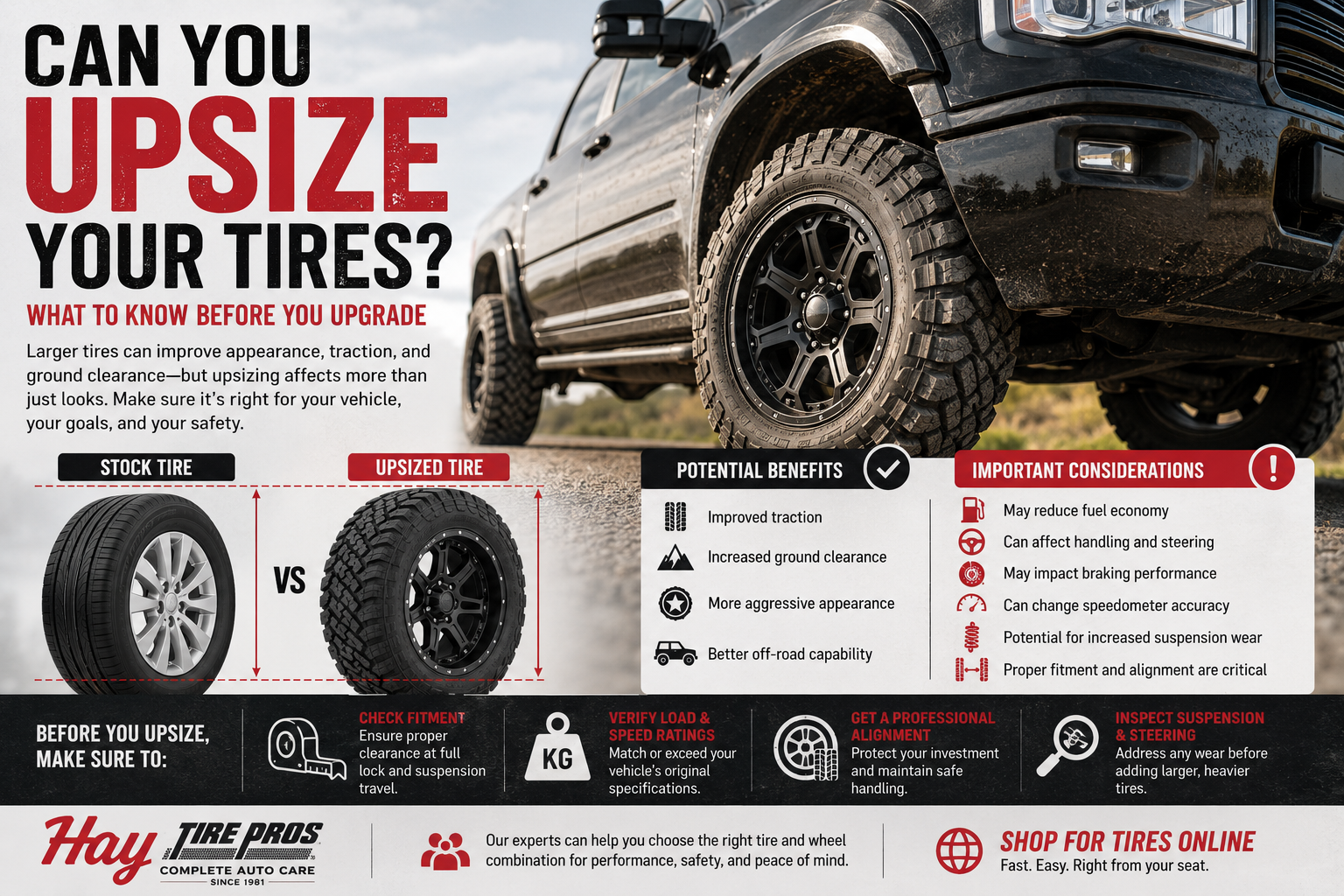
Can You Upsize Your Tires? What to Know Before Installing Larger Tires
Larger tires can change the appearance and capability of a vehicle, but tire upsizing is not simply a matter of choosing a size that fits inside the wheel well.
Changing tire size can affect steering response, ride comfort, braking, fuel economy, speedometer accuracy, suspension wear, and the operation of electronic safety systems. The results depend on how much larger the tire is, whether the wheel size also changes, and whether the new tire maintains the vehicle’s required load capacity and clearance.
In many cases, tires can be upsized safely. The key is choosing a size that remains compatible with the vehicle’s wheels, suspension geometry, braking system, drivetrain, and intended use.
Before making the change, drivers should understand both the potential benefits and the compromises that come with moving away from the original tire specification.
What Does It Mean to Upsize Your Tires?
Upsizing means installing a tire that is larger in one or more dimensions than the size originally specified by the vehicle manufacturer.
A tire size change may involve increasing:
- Tire width
- Sidewall height
- Overall tire diameter
- Wheel diameter
- Wheel width
These changes do not all produce the same result.
Some drivers install a larger-diameter tire to increase ground clearance. Others select a wider tire to create a more aggressive stance or increase the available contact area. Performance-oriented drivers may install a larger wheel with a lower-profile tire while keeping the overall tire diameter close to the original specification.
That last approach is commonly called plus sizing.
For example, a vehicle equipped with a 17-inch wheel may be changed to an 18-inch wheel with a shorter tire sidewall. When properly calculated, the new wheel-and-tire combination can maintain an overall diameter similar to the factory setup.
Maintaining a similar overall diameter helps limit changes to speedometer accuracy, transmission behavior, gearing, and electronic vehicle systems.
Every vehicle has practical fitment limits. Wheel-well clearance, suspension travel, steering angle, wheel offset, brake clearance, load capacity, and manufacturer specifications must all be considered. Consulting a trusted tire shop in Charleston before changing sizes can help prevent rubbing, uneven wear, poor handling, and costly component damage.
Why Do Drivers Install Larger Tires?
Drivers consider tire upsizing for several reasons.
Truck and SUV owners may want additional ground clearance, improved off-road traction, or a more substantial appearance. Performance-car owners may choose wider tires to increase dry-road grip and steering response. Other drivers simply prefer the appearance of a larger wheel-and-tire package.
Depending on the vehicle and the selected tire, possible benefits may include:
- A wider or more aggressive stance
- Increased ground clearance
- Improved traction in specific conditions
- Better off-road capability
- More responsive dry-road cornering
- Additional wheel and tire customization options
Those benefits are not guaranteed simply because a tire is larger. Tire compound, tread design, inflation pressure, wheel width, vehicle weight, and road conditions may influence performance as much as tire size.
A larger all-terrain tire, for example, may improve loose-surface traction while producing more road noise and less precise handling on pavement. A wider performance tire may improve dry grip but be more susceptible to hydroplaning in standing water if the design is not appropriate for the conditions.
The entire tire specification matters—not just the measurements printed on the sidewall.
How Much Larger Can You Go?
There is no universal tire-size increase that is safe for every vehicle.
A common fitment goal is to keep the replacement tire’s overall diameter relatively close to the original tire diameter. This helps reduce changes to speedometer readings, gearing, transmission shift behavior, and electronic safety systems.
However, acceptable variation depends on the vehicle. Even a modest diameter increase can create clearance problems on a vehicle with limited wheel-well space, while some trucks and SUVs may accommodate a larger increase with the correct wheels, suspension setup, and alignment.
Before approving an upsized tire, a qualified technician should verify:
- Overall tire diameter
- Tire width
- Wheel width
- Wheel diameter
- Wheel offset and backspacing
- Load index
- Speed rating
- Brake-caliper clearance
- Suspension clearance
- Fender and wheel-well clearance
- Clearance at full steering lock
- Clearance throughout suspension travel
A tire that clears the body while the vehicle is parked may still rub when turning sharply, carrying passengers, towing, driving over bumps, or compressing the suspension.
That is why visual clearance alone is not enough to confirm proper fitment.
Tire Width and Wheel Width Must Be Compatible
A wider tire does not automatically fit correctly on the vehicle’s existing wheel.
Every tire size has an approved wheel-width range. Installing a tire on a wheel that is too narrow or too wide can change the shape of the tread and sidewall. That may affect handling, bead security, tread wear, ride quality, and the tire’s ability to carry its rated load.
A tire mounted on an excessively narrow wheel may have a pinched appearance and reduced tread stability. A tire mounted on an overly wide wheel may have stretched sidewalls that provide less protection from impact damage.
The replacement wheel must also have the correct:
- Diameter
- Bolt pattern
- Center bore
- Offset
- Load capacity
- Brake clearance
Wheel offset is especially important. Moving the wheel too far inward may cause contact with suspension or steering components. Moving it too far outward can increase fender interference and place additional leverage on wheel bearings and suspension parts.
Proper upsizing requires evaluating the tire and wheel as one complete assembly.
Load Index and Speed Rating Still Matter
A replacement tire must be capable of supporting the vehicle’s weight and expected operating loads.
The load index identifies how much weight the tire can carry at its specified pressure. Installing a larger tire does not necessarily mean the tire has a higher load capacity. Some replacement sizes may have a lower load index than the factory tire even though they appear physically larger.
The new tire should meet or exceed the load requirements specified for the vehicle unless a qualified professional and the applicable manufacturer guidance indicate otherwise.
This becomes especially important for:
- Pickup trucks
- SUVs
- Commercial vehicles
- Vehicles used for towing
- Vehicles carrying tools or equipment
- Vehicles regularly operated near maximum payload
The speed rating should also remain appropriate for the vehicle and its use.
Choosing tires based only on appearance can lead to an assembly that fits physically but does not meet the vehicle’s load, speed, or performance requirements.
How Larger Tires Affect Handling and Steering
Changing tire width, diameter, sidewall height, and wheel offset can alter how a vehicle responds to steering inputs.
A wider tire may provide additional dry-road grip, particularly when the tire compound and wheel width are appropriate. However, it may also increase steering effort, follow grooves in the pavement more noticeably, or make the vehicle feel less predictable on uneven roads.
Larger and heavier tire assemblies can also slow steering response because the steering system must move more mass.
Changes may include:
- Heavier steering feel
- Increased sensitivity to road grooves
- Slower steering response
- Different cornering balance
- Increased steering kickback on rough surfaces
- A larger turning radius in some applications
If the new wheel offset changes the scrub radius—the relationship between the steering axis and the tire’s contact point with the road—the vehicle may behave differently during braking, turning, and acceleration.
Substantial offset changes can also increase stress on wheel bearings, tie rods, ball joints, and other steering components.
How Upsizing Affects Ride Comfort
The effect on ride quality depends on how the tire is upsized.
Installing a larger wheel with a lower-profile tire usually reduces sidewall height. Because the sidewall helps absorb impacts and road irregularities, a shorter sidewall often creates a firmer ride.
Drivers may notice:
- More vibration over rough pavement
- Sharper impacts from potholes
- Additional road noise
- Increased risk of wheel damage
- Greater sensitivity to tire pressure
A larger-diameter tire with a taller sidewall may have a different effect. It may soften certain impacts, but the heavier tire can make the suspension work harder and may reduce control over bumps if the shocks and struts are not designed for the added unsprung weight.
Ride quality also depends on the tire’s internal construction, tread pattern, load rating, and inflation pressure. Two tires of the same size can produce noticeably different ride characteristics.
Will Larger Tires Reduce Fuel Economy?
Larger tires can reduce fuel economy, although the amount varies by vehicle and tire selection.
Several factors may contribute:
- Increased tire and wheel weight
- Greater rotational inertia
- Higher rolling resistance
- More aggressive tread patterns
- Increased aerodynamic drag from a wider stance
- Changes in effective gearing
Heavier tires require more energy to accelerate. A larger outside diameter also changes the vehicle’s effective final-drive ratio, which can make the engine work harder during acceleration or when climbing hills.
On trucks and SUVs, moving from a factory highway tire to a much larger all-terrain or mud-terrain tire may produce a more noticeable fuel-economy reduction than a conservative plus-size change on a passenger car.
The effect should be considered carefully by drivers who travel long distances, commute daily, or prioritize operating efficiency.
How Tire Upsizing Affects Acceleration and Gearing
A larger overall tire diameter effectively creates taller gearing.
Because the tire travels farther during each rotation, the engine may turn fewer revolutions at a given road speed. That can sound beneficial, but it also reduces the torque delivered to the pavement.
Possible effects include:
- Slower acceleration
- More frequent transmission downshifts
- Reduced towing response
- Increased strain when climbing hills
- Less responsive low-speed performance
Vehicles with smaller engines or factory gearing designed around the original tire size may be more sensitive to these changes.
Substantial tire-size increases on trucks and off-road vehicles sometimes require changes to axle gearing to restore the intended acceleration, towing performance, and transmission behavior.
Can Larger Tires Affect Braking?
Yes. Larger and heavier tire-and-wheel assemblies can affect braking performance.
The braking system must slow the rotating mass of the wheel and tire. When that mass increases, the brakes may need to absorb more energy during a stop.
Depending on the size change, vehicle, tire grip, and braking system, the driver may notice:
- Longer stopping distances
- Increased brake temperature
- Faster brake-pad wear
- Reduced braking consistency during repeated stops
- A heavier or less responsive feel
A wider, high-quality tire may provide more available traction under some conditions, but additional grip does not eliminate the effects of increased rotational weight.
Braking performance is determined by the complete system, including the tires, brake pads, rotors, calipers, suspension, alignment, road surface, and electronic controls.
How Larger Tires Affect Speedometer Accuracy
The speedometer and odometer are calibrated using the expected number of tire rotations over a given distance.
When overall tire diameter increases, the tire travels farther with each revolution. The vehicle may therefore be moving faster and traveling farther than the displayed values indicate.
For example, the speedometer might show 60 mph while the vehicle is actually traveling several miles per hour faster. The exact difference depends on the percentage change in tire circumference.
An incorrect tire diameter may affect:
- Speedometer readings
- Odometer mileage
- Transmission shift points
- Cruise-control operation
- Fuel-economy calculations
- Maintenance reminders
Some vehicles can be recalibrated for a different tire size through programming or aftermarket equipment. Others have a limited range of acceptable factory-supported sizes.
Speedometer accuracy should be checked after any meaningful change in overall tire diameter.
Electronic Safety Systems May Be Affected
Modern vehicles rely on wheel-speed data for several important systems.
These may include:
- Antilock braking
- Traction control
- Electronic stability control
- All-wheel-drive operation
- Adaptive cruise control
- Transmission controls
- Tire-pressure monitoring
Using tires with a significantly different rolling circumference can alter the information those systems receive.
All four tires should generally have matching or manufacturer-approved rolling circumferences. Mixing substantially different tire diameters between axles can be especially problematic on all-wheel-drive and four-wheel-drive vehicles.
Even small circumference differences caused by mismatched sizes or uneven tread depth may place stress on certain AWD systems.
Drivers should not assume that a tire is compatible simply because it mounts on the wheel and clears the fender.
Why Alignment Matters After Installing Larger Tires
A wheel alignment does not make an incompatible tire size compatible, but it is an important part of a properly planned tire upgrade.
Larger or wider tires can make existing alignment problems more noticeable. A small toe or camber issue that produced gradual wear on the factory tires may wear an expensive upsized tire much more quickly.
Poor alignment can contribute to:
- Inner- or outer-edge wear
- Feathered tread
- Steering pull
- An off-center steering wheel
- Reduced stability
- Increased rolling resistance
- Shortened tire life
Changing wheel offset, suspension height, or ride height can also affect alignment geometry.
At Hay Tire Pros Complete Auto Care, alignment evaluation is an important part of planning a tire or wheel change. An alignment should be performed according to the vehicle’s specifications after modifications that affect ride height or suspension geometry.
Because upsized tires can cost considerably more than factory-size replacements, correcting alignment issues early helps protect the investment.
Suspension and Steering Components Should Be Inspected
Larger tires may place additional load on components that support and control the wheel assembly.
The extent of that added stress depends on the tire’s weight, wheel offset, vehicle design, road conditions, and how the vehicle is driven.
Suspension Components that may be affected include:
- Wheel bearings
- Ball joints
- Tie rods
- Control-arm bushings
- Shocks and struts
- Steering racks
- CV axles
- Hub assemblies
Existing looseness or wear may become more noticeable after larger tires are installed. A worn wheel bearing, weak shock, or loose ball joint can also contribute to irregular tread wear and poor handling.
A full-service auto repair facility in Charleston can inspect the suspension, steering, brakes, and wheel bearings before installation. Addressing worn components beforehand provides a more stable foundation for the new tire-and-wheel package.
Check Clearance Under Real Driving Conditions
A tire may appear to fit correctly while the vehicle is stationary but rub once the suspension moves or the steering reaches full lock.
Clearance should be checked:
- With the steering turned fully left and right
- Under suspension compression
- During body roll
- With passengers or cargo
- While reversing and turning
- Over bumps and driveway entrances
- With snow chains, when applicable
Common contact points include:
- Inner fender liners
- Strut housings
- Control arms
- Sway bars
- Mud flaps
- Fender edges
- Bumpers
- Frame components
Tire rubbing is not merely a cosmetic concern. Continued contact can damage the tire’s sidewall or tread and may eventually cause a failure.
Do Larger Tires Require a Lift or Leveling Kit?
Not every tire upgrade requires suspension modification.
A conservative plus-size setup may fit on the original suspension. More substantial increases in diameter or width may require a leveling kit, suspension lift, wheel-offset change, trimming, or another modification.
However, adding a lift does not automatically solve every fitment issue. A lift may increase vertical clearance while doing little to improve clearance at full steering lock. Changes in suspension height can also affect alignment, CV-joint angles, handling, braking, and rollover characteristics.
Any suspension modification should be evaluated as part of the complete vehicle setup rather than as a shortcut for fitting the largest possible tire.
Will Upsizing Affect the Vehicle Warranty?
Installing a different tire size does not automatically eliminate every part of a vehicle warranty. However, a manufacturer or warranty provider may deny coverage for a failure if the modification caused or contributed to the problem.
For example, an excessively heavy or improperly offset wheel-and-tire combination could potentially contribute to premature wheel-bearing or suspension wear.
Drivers with newer vehicles should review:
- The owner’s manual
- Tire and loading information label
- Warranty terms
- Approved accessory information
- Manufacturer-supported tire sizes
Insurance requirements and local equipment regulations may also apply when tire size substantially changes vehicle height, tire coverage, or speedometer accuracy.
Is Tire Upsizing Right for Your Vehicle?
Upsizing can work well when the new tire and wheel combination is carefully selected for the vehicle and the driver’s goals.
Before making the change, consider:
- How the vehicle is normally driven
- Whether it is used for towing or hauling
- Desired ride quality
- Fuel-economy priorities
- Ground-clearance requirements
- Steering and handling expectations
- Tire replacement cost
- Wheel and suspension condition
- Manufacturer recommendations
- Speedometer recalibration
- Alignment requirements
For a daily commuter, maintaining ride comfort, efficiency, and predictable wet-weather handling may be more important than maximizing tire size.
For an off-road truck, additional clearance and traction may justify some increase in noise, weight, and fuel consumption.
The correct setup is the one that supports the vehicle’s actual use—not necessarily the largest tire that can be made to fit.
Get Professional Tire Fitment Advice From Hay Tire Pros
The answer to “Can you upsize your tires?” is often yes, but the change should be based on verified measurements and vehicle requirements rather than appearance alone.
Hay Tire Pros Complete Auto Care has served drivers throughout Charleston, Mount Pleasant, and Moncks Corner since 1981. Our team can help evaluate tire size, wheel compatibility, load capacity, clearance, alignment, suspension condition, and the way you use your vehicle.
Whether you are shopping for new tires, scheduling an oil change in Charleston, or looking for trusted auto repair services, we can help you make a tire choice that supports safe handling and dependable long-term performance.
Before installing a larger tire-and-wheel package, have the vehicle inspected and the proposed fitment reviewed. A properly selected setup can deliver the appearance or capability you want without creating avoidable rubbing, premature tire wear, inaccurate speed readings, or unnecessary stress on the vehicle.