
Do Wider Tires Improve Handling?
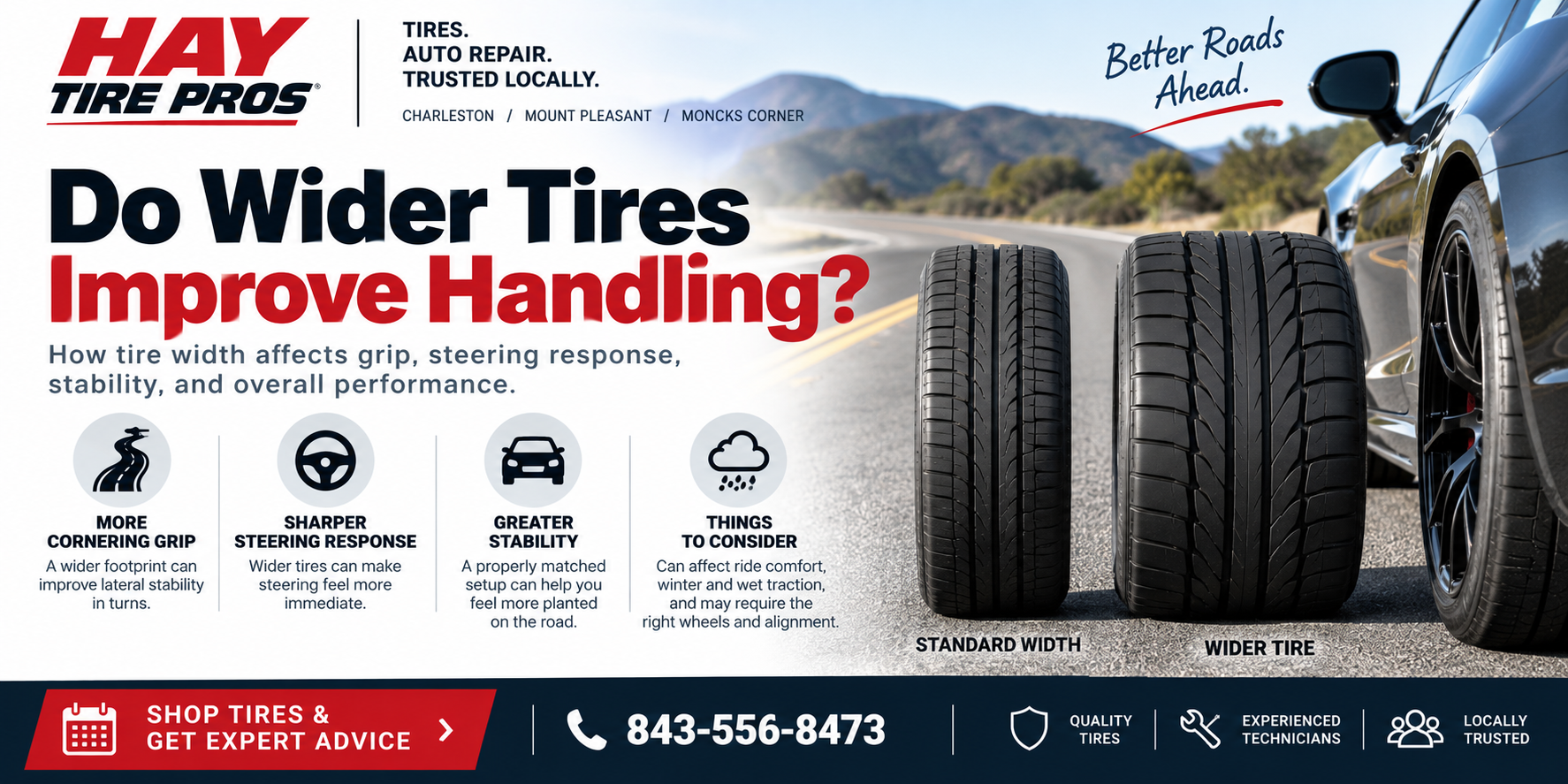
Wider tires can improve handling, particularly dry-road cornering grip, steering response, and lateral stability, but simply installing the widest tire that fits does not automatically make a vehicle handle better.
Tire width is only one part of the equation. Tire compound, tread design, wheel width, sidewall height, inflation pressure, alignment, suspension geometry, and vehicle weight all affect how much grip and steering response a tire can produce.
A properly matched wider tire can make a car feel more responsive and planted in corners. An improperly matched one can make steering heavier, increase tramlining, reduce wet-weather performance, and even make handling less predictable.
Drivers considering a different tire size can explore Hay Tire Pros’ tire selection and tire services, or learn more about upsizing tires before changing from the original equipment size.
Do Wider Tires Actually Improve Handling?
Wider tires can improve dry-road lateral grip and steering response when the tire, wheel, suspension, and vehicle are properly matched. Width alone does not guarantee better handling.
Performance vehicles frequently use wider tires because a wider tread footprint can improve lateral stability and help the tire resist deformation during hard cornering.
But comparing tire width by itself is misleading.
A narrower high-performance tire may provide substantially more grip than a wider touring tire because it has a more aggressive compound, stronger construction, and a tread pattern designed for performance.
The correct question is therefore not simply: “Is a wider tire better?”
It is: “Is this wider tire-and-wheel combination better suited to this vehicle and how it is driven?”
Why Can Wider Tires Provide More Cornering Grip?
Wider tires generally create a shorter, wider contact-patch shape that can improve lateral stability and responsiveness during cornering.
The contact patch is the portion of the tread that touches the road at any given moment.
One common misconception is that increasing tire width automatically creates a proportionally larger contact-patch area. Vehicle load and tire pressure have a major influence on total footprint area.
Changing tire dimensions instead changes the shape of that footprint.
A wider, lower-profile performance tire tends to produce a shorter and wider footprint. This shape can provide greater lateral stability and help the tire respond more directly to steering inputs.
That is one reason sports cars commonly use wider, lower-profile tires than economy vehicles.
Does a Wider Tire Put More Rubber on the Road?
Not necessarily in the simple way people often assume. At a given vehicle load and inflation pressure, tire width changes the shape of the contact patch more than it changes its total area.
Think of two footprints with similar overall areas.
One may be long and narrow. The other may be short and wide.
The wider footprint can be advantageous for cornering because more of the tread is distributed laterally across the road, and the tread can resist cornering forces differently.
Grip is also affected by the tire’s rubber compound, tread stiffness, temperature, road surface, and construction.
That is why tire width should never be used as the sole predictor of traction.
Do Wider Tires Improve Steering Response?
Wider tires can sharpen steering response, especially when paired with a properly sized wheel and a lower-profile sidewall.
When the steering wheel turns, the tire does not respond as if it were a completely rigid object. Its sidewall and tread deform as cornering forces build.
Performance-oriented wider tires are often paired with wider wheels and shorter sidewalls, which can reduce some of this movement and make steering inputs feel more immediate.
Wheel width matters considerably.
Installing a wider tire on a wheel near the narrow end of the tire manufacturer’s approved wheel-width range can allow the sidewall to bulge outward. That extra sidewall movement may actually make steering feel slower.
A properly supported tire on an appropriately sized wheel generally responds more predictably.
Does Wheel Width Matter With Wider Tires?
Yes. Wheel width can affect sidewall shape, steering response, tread support, and how effectively a wider tire performs.
Every tire size has an approved range of wheel widths.
A tire mounted on a wheel that is too narrow can become pinched, allowing the sidewalls to curve outward excessively. The tire may fit physically, but fail to deliver the handling improvement the driver expected.
A wider wheel within the tire manufacturer’s approved range generally provides greater tread and sidewall support.
This is one reason simply installing wider tires on the original wheels does not always improve performance.
Hay Tire Pros discusses wheel compatibility, offset, clearance, and tire dimensions in greater detail in its guide to upsizing tires and wheels.
Can Wider Tires Make Handling Worse?
Yes. Excessive tire width can increase steering effort, tramlining, road sensitivity, weight, and interference problems without providing a meaningful increase in usable grip.
More is not always better.
A tire that is excessively wide for the vehicle can change steering feel and make the car more sensitive to pavement grooves.
This behavior is commonly called tramlining. The tires tend to follow grooves, seams, and uneven sections of pavement, requiring more steering corrections from the driver.
Very wide tires may also produce heavier steering and greater kickback over rough surfaces.
The ideal tire width is therefore a balance between traction, responsiveness, ride quality, wet-weather behavior, and compatibility with the vehicle.
Do Wider Tires Improve Braking?
Wider tires can provide greater dry braking traction in some applications, but tire compound and construction often matter more than width alone.
Braking performance depends on how effectively the tires can generate friction before reaching their traction limit.
A properly selected, wider performance tire may improve dry braking because it is engineered to deliver high levels of grip.
However, simply replacing a narrow performance tire with a wider tire made from a less capable compound may actually reduce braking performance.
Wheel and tire weight also matters. Very large wheels and tires increase rotating and unsprung mass, which can affect acceleration, braking, and suspension response.
For that reason, tire width should be evaluated as part of the complete wheel-and-tire package.
Are Wider Tires Better in Rain?
Not automatically. Wider tires can be more susceptible to hydroplaning because they must move more water away from a broader footprint.
Wet traction depends heavily on tread design, tread depth, rubber compound, vehicle speed, and water depth.
A wider tire has to displace water across a broader footprint. Under otherwise similar conditions, increasing tire width can increase hydroplaning susceptibility.
That does not mean every narrow tire performs better in the rain than every wide tire.
Modern performance tires use grooves and tread patterns specifically designed to evacuate water efficiently. A high-quality wide tire can perform extremely well in wet conditions.
But tire width alone should never be interpreted as a wet-weather advantage.
Are Wider Tires Better in Snow?
Wider tires are generally not an advantage in deep or loose snow. A narrower tire can concentrate vehicle weight over a smaller width and cut through snow more effectively.
Performance on snow is determined primarily by tire type, tread pattern, compound, and winter conditions.
A dedicated narrow winter tire can outperform a much wider summer or all-season tire because winter compounds remain flexible at low temperatures, and the tread is designed to grip snow and ice.
For Charleston-area drivers, snow performance is rarely the primary concern, but the same principle demonstrates why tire width alone cannot determine traction.
The correct tire type for the conditions matters more.
Do Wider Tires Affect Ride Quality?
Wider tires can produce a firmer or harsher ride, particularly when they also have a lower-profile sidewall.
Many wider tire upgrades involve increasing wheel width or diameter while reducing sidewall height.
A shorter sidewall flexes less during cornering, which can improve response, but it also provides less cushioning over potholes, expansion joints, and rough pavement.
Drivers may notice:
- Sharper steering
- More road feedback
- Increased impact harshness
- More road noise
- Greater sensitivity to uneven pavement
Whether that feels better depends on what the driver wants from the vehicle.
A sports-car driver may appreciate the additional feedback. Someone prioritizing comfort may prefer the original tire dimensions.
Do Wider Tires Reduce Fuel Economy?
Wider tires can reduce fuel economy if they increase rolling resistance, aerodynamic drag, or wheel-and-tire weight.
The effect varies significantly by tire.
A wider footprint may increase rolling resistance, while a heavier wheel-and-tire assembly requires more energy to accelerate.
Tire construction and compound can offset some of these effects, which is why two tires of the same size may have different rolling-resistance characteristics.
For a modest increase in width, the difference may be relatively small. Large wheel-and-tire upgrades can make the change more noticeable.
Can You Put Wider Tires on the Same Wheels?
Sometimes. The new tire must list your wheel width within its manufacturer-approved rim-width range.
For example, two different tire widths may both be approved for an 8-inch-wide wheel.
That does not mean every tire that physically mounts on the wheel is appropriate.
An excessively wide tire mounted on a narrow wheel may exhibit excessive sidewall bulge and reduced steering precision.
Before changing tire size, verify:
- Approved wheel-width range
- Tire load index
- Speed rating
- Overall diameter
- Vehicle clearance
- Wheel offset
- Suspension clearance
- Fender clearance
Hay Tire Pros can help drivers compare compatible tire sizes at its tire shops in Charleston, Mount Pleasant, and Moncks Corner.
Does Tire Width Change Overall Tire Diameter?
Tire width can change overall diameter unless the aspect ratio is adjusted at the same time.
Consider a tire marked 225/50R17.
The 225 represents nominal section width in millimeters. The 50 means the sidewall height is approximately 50% of that width.
If you simply move to a 245/50R17 tire, both the width and sidewall height increase. That also increases overall tire diameter.
A properly calculated wider replacement might therefore use a lower aspect ratio to keep overall diameter close to the original specification.
Significant diameter changes can affect speedometer readings, gearing, clearance, ABS, traction control, and stability-control operation.
That is why tire upsizing should involve more than selecting a wider number on the sidewall.
Does Wheel Offset Matter When Installing Wider Tires?
Yes. Wheel offset determines where the tire sits relative to the suspension and fender, and can also affect steering geometry.
A wider tire needs additional space.
Too much inward placement can cause the tire to contact struts, control arms, or other suspension components. Too much outward placement can cause fender interference.
Changing the offset also changes the relationship between the steering axis and the tire’s contact point.
Large offset changes can therefore alter steering effort, feedback, kickback, and bearing loads even if the tire itself clears the bodywork.
Correct fitment requires considering tire width, wheel width, and wheel offset together.
Do Wider Tires Need an Alignment?
Simply installing a slightly wider tire does not automatically change alignment angles, but alignment should be checked when tire wear or handling suggests a problem or when suspension geometry has been modified.
Alignment determines how the tires meet the road.
Incorrect toe or camber can reduce steering precision and quickly wear the inner or outer edges of expensive, wider tires.
Suspension modifications, ride-height changes, and some wheel fitment changes can also affect vehicle geometry.
Hay Tire Pros provides wheel alignment service in Charleston, Mount Pleasant, and Moncks Corner, measuring and adjusting alignment to vehicle specifications.
Can Worn Suspension Cancel Out the Benefits of Better Tires?
Yes. Worn shocks, struts, bushings, ball joints, tie rods, or wheel bearings can reduce stability and tire control regardless of tire width.
The suspension keeps each tire correctly positioned against the road.
If components are loose or worn, installing wider or higher-performance tires does not repair the underlying handling problem.
Symptoms such as wandering, excessive body movement, uneven tire wear, clunking, or unstable steering should be inspected before using tires as a handling upgrade.
Hay Tire Pros provides steering and suspension repair for shocks, struts, steering components, springs, and related suspension problems.
Should You Install Wider Tires for Better Handling?
Wider tires make sense when the vehicle can accommodate them properly, and the change provides a useful performance benefit without creating unwanted compromises.
A modest, properly engineered increase in tire width can improve dry-road response and cornering stability.
But tire quality is more important than chasing maximum width.
For many drivers, moving to a better tire in the factory size can provide a larger real-world improvement than simply installing a wider tire.
Before changing sizes, consider:
- What type of driving you do
- Dry versus wet performance
- Ride comfort
- Tire and wheel weight
- Wheel width
- Clearance
- Alignment
- Tire cost
- Fuel economy
- Manufacturer recommendations
The best tire setup is the one that improves the characteristics you actually care about without compromising the rest of the vehicle.
Tire Selection and Wheel Alignment in Charleston, SC
Drivers interested in improving traction or handling do not necessarily need the widest tire available.
Choosing the right combination of tire size, compound, tread design, wheel width, inflation pressure, and alignment provides a more useful approach.
Hay Tire Pros helps drivers select and maintain tires in Charleston, Mount Pleasant, and Moncks Corner, offering services such as new tires, wheel alignment, tire balancing, rotation, and steering and suspension repair.