
How to Tell Tire Age
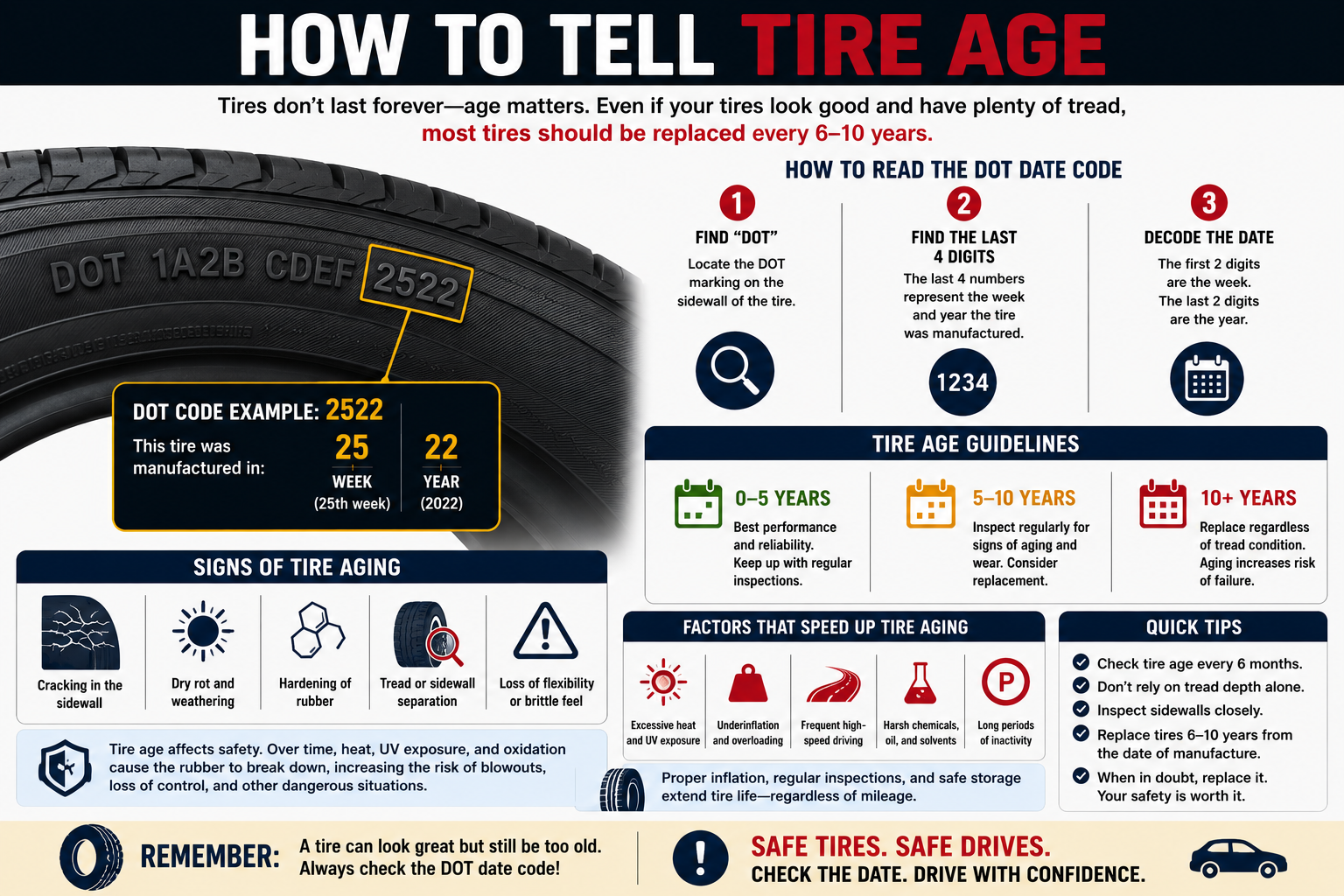
How to Tell Tire Age: DOT Codes, Warning Signs, and When to Replace Your Tires
Tires do not become unsafe based on mileage alone. The rubber compounds, internal bonding materials, and structural components inside a tire gradually change as the tire ages—even when the tread still appears deep and the sidewalls look relatively clean.
That is where many drivers make a costly mistake. A low-mileage tire is not automatically a safe tire. Tires on weekend vehicles, secondary cars, trailers, work trucks, and vehicles that spend long periods parked may reach the end of their recommended service life before the tread wears down.
The most reliable way to begin evaluating tire age is to find the tire’s manufacture date, inspect its physical condition, and compare its age with the recommendations provided by the tire manufacturer and vehicle manufacturer.
At Hay Tire Pros Complete Auto Care, we regularly inspect tires for drivers throughout Charleston, Mount Pleasant, and Moncks Corner. When replacement becomes necessary, drivers can also shop for tires online by vehicle, tire size, driving needs, and budget before scheduling installation.
Where to Find the Tire Manufacture Date (DOT CODE)
Every tire approved for highway use in the United States has a Tire Identification Number, commonly called the DOT code, molded into its sidewall. The code contains information identifying the manufacturing plant, tire size or type, and date of manufacture.
To determine the tire’s age, look at the final four digits of the Tire Identification Number.
The first two digits indicate the week of manufacture. The final two digits indicate the year.
For example:
DOT XXXX 2522
In this example:
25 means the tire was manufactured during the 25th week of the year.
22 means the tire was manufactured in 2022.
The tire was therefore manufactured in approximately June 2022.
The complete Tire Identification Number may appear on only one side of the tire. If you do not see the date code on the outward-facing sidewall, it may be located on the side facing the vehicle. A technician may need to raise the vehicle or inspect behind the wheel to read it clearly.
NHTSA confirms that the final four digits of the Tire Identification Number identify the week and year in which the tire was manufactured.
What Does a Three-Digit DOT Date Code Mean?
Modern tires use a four-digit date code. Tires manufactured before 2000 used a three-digit system that did not clearly identify the decade.
Any tire with a three-digit manufacture code is now more than 25 years old. It should not remain in normal road service, regardless of its tread depth or outward appearance.
Why Tire Age Matters Even When the Tread Looks Good
Tires are made from rubber compounds, reinforcing materials, steel belts, fabric cords, bonding agents, and other components engineered to function together as a single structure.
Over time, environmental exposure and normal use can change those materials. Factors that contribute to tire aging include:
- Heat and repeated temperature cycles
- Oxygen and ozone exposure
- Ultraviolet radiation
- Moisture and humidity
- Improper storage
- Underinflation or overloading
- Long periods of inactivity
As the rubber ages, it may gradually lose elasticity and become harder. Internal adhesion between tire components can also deteriorate. These changes may reduce wet-weather traction, increase cracking, and make the tire more vulnerable to structural failure.
Continental describes tire aging as a combination of chemical and physical processes that gradually alter the tire’s material properties. Heat, humidity, oxygen, ozone, moisture, and ultraviolet radiation can all contribute to that process.
The important point is that tread depth and tire age measure two different things.
Tread depth indicates how much usable tread remains. The manufacture date indicates how long the tire’s materials have been aging. A tire can pass a basic tread-depth check while still requiring closer evaluation because of its age, storage history, cracking, vibration, or structural condition.
How Long Do Tires Last?
There is no single expiration date that applies to every tire, vehicle, and operating environment. Tire life depends on the tire manufacturer, vehicle manufacturer, tire design, inflation history, driving conditions, storage conditions, maintenance, and climate.
That is why drivers should check the recommendations in the vehicle owner’s manual and from the tire manufacturer rather than relying on one universal mileage or age rule.
NHTSA notes that some vehicle and tire manufacturers recommend replacing tires between six and 10 years of age, regardless of remaining tread. The agency also explains that tires become more prone to failure as they age.
Michelin recommends having tires professionally inspected at least annually after five years of use. As a precaution, Michelin recommends replacing its tires by 10 years from the manufacture date, even when they appear usable and have not reached the legal tread-wear limit.
A practical approach is to treat tire age as an inspection trigger:
Around five years: Begin paying closer attention to age, condition, use, and manufacturer guidance.
Around six years and beyond: Have the tires inspected regularly and determine whether the vehicle or tire manufacturer recommends replacement.
At 10 years: Many manufacturers recommend replacement as a precaution, regardless of tread depth. Always follow the applicable manufacturer’s instructions.
Age is not the only deciding factor. A tire may require replacement much earlier because of cracking, impact damage, puncture history, underinflation, overloading, tread wear, belt separation, or another structural concern.
Charleston Driving Conditions Can Affect Tire Aging
Drivers in Charleston and the surrounding Lowcountry should pay particular attention to tire age and condition. Warm temperatures, prolonged sun exposure, high humidity, outdoor parking, and frequent heat cycles can place additional stress on rubber components.
NHTSA specifically identifies warmer climates and sunlight exposure as factors that can contribute to tire aging. The agency also notes that tire-aging concerns may be greater in southern regions and among vehicles that are not driven regularly.
Local driving conditions can also affect how tires age and wear. Stop-and-go traffic, rough pavement, potholes, improper inflation, misalignment, and extended highway driving during hot weather can all influence tire condition.
This does not mean every tire in a warm climate will fail early. It means tire age should be evaluated alongside the tire’s actual condition and operating history.
Visible Signs of an Aging or Damaged Tire
The DOT code tells you when a tire was manufactured, but it cannot tell you whether that tire has been maintained correctly or damaged during use. A physical inspection is still necessary.
Warning signs that deserve attention include:
- Cracks in the sidewall or between tread blocks
- Dry, brittle, or unusually hard rubber
- Bulges, bubbles, or localized deformation
- Cuts or exposed reinforcing cords
- Uneven or irregular tread wear
- Repeated loss of inflation pressure
- Vibration that changes with vehicle speed
- Pieces of tread lifting or separating
- Unusual noise from one wheel or tire
- Reduced traction, particularly on wet roads
A bulge or bubble can indicate damage to the tire’s internal structure and should be evaluated immediately. Exposed cords, severe cracking, tread separation, or significant deformation are also reasons to remove a tire from service rather than continue driving on it.
However, the absence of visible cracking does not prove that an older tire is safe. NHTSA cautions that tire aging cannot always be detected simply by looking at the exterior.
Why Low-Mileage Tires Can Still Become Unsafe
Drivers sometimes assume that rarely used tires should last indefinitely because they have experienced little tread wear. In reality, occasional-use vehicles can be especially vulnerable to age-related problems because their tires may remain installed for many years.
Low-mileage tires do not necessarily age faster than regularly used tires. The concern is that they often age out before they wear out.
This frequently affects:
- Weekend and collector vehicles
- Secondary household vehicles
- Seasonal work trucks
- Recreational vehicles
- Trailers
- Vehicles belonging to drivers who work from home
- Full-size spare tires
While the vehicle is parked, the tires continue to experience oxygen, ozone, sunlight, humidity, temperature changes, and the vehicle’s static load. Tires may also develop flat spotting or lose pressure while sitting.
Because the tread remains deep, the owner may assume the tires are nearly new even though the rubber and internal materials have been aging for years.
NHTSA identifies low annual mileage and infrequent vehicle use as situations in which tire aging deserves additional attention.
Do Not Forget to Check the Spare Tire
A spare tire may be the oldest tire on the vehicle. Because it is rarely used, it can retain nearly all its original tread while quietly aging in the trunk, under the cargo area, or beneath the vehicle.
Check the spare tire for:
- Manufacture date
- Correct inflation pressure
- Cracking or dry rot
- Corrosion around the wheel
- Damage to the valve stem
- Proper mounting and accessibility
NHTSA warns that spare tires are especially susceptible to age-related concerns because they are replaced so infrequently. A full-size spare should not automatically be treated as a permanent replacement for a worn road tire simply because its tread looks unused.
A spare that is flat, damaged, or too old to use safely will not provide much help during a roadside emergency.
When Should an Older Tire Be Replaced?
Replacement decisions should consider the complete condition of the tire rather than age or mileage alone.
A tire may need replacement when:
- It has reached the age limit identified by its manufacturer
- It is approaching 10 years from manufacture
- Cracking or rubber deterioration is visible
- A bulge, bubble, or deformation appears
- The tire repeatedly loses pressure
- Tread wear has reached the legal or manufacturer-specified limit
- The tire has uneven wear that cannot be corrected
- Internal damage or separation is suspected
- The vehicle develops tire-related vibration or noise
- Wet-weather grip has noticeably declined
- The tire has been driven while severely underinflated
- The tire has suffered nonrepairable impact or puncture damage
Do not assume that an old tire is safe because it passed a quick visual check. Likewise, age alone does not tell a technician everything about a tire’s condition. The safest decision comes from combining the date code, physical inspection, maintenance history, driving conditions, manufacturer guidance, and vehicle application.
What a Professional Tire Inspection Should Include
Most drivers do not regularly inspect the inward-facing sidewalls, measure tread depth across the entire tire, or compare wear patterns among all four wheels. A professional inspection provides a more complete evaluation.
At Hay Tire Pros Complete Auto Care, a tire inspection may include:
- DOT manufacture-date verification
- Tread-depth measurements at multiple points
- Sidewall and tread-area inspection
- Inflation-pressure check
- Valve-stem and TPMS evaluation
- Uneven-wear analysis
- Inspection for cuts, punctures, bulges, or deformation
- Rotation and balancing recommendations
- Wheel-alignment evaluation
- Review of tire size, load rating, and application
Wear patterns can also reveal concerns elsewhere in the vehicle. Feathering may suggest an alignment problem. Cupping can be associated with imbalance or worn suspension components. Excessive shoulder wear may result from underinflation, while accelerated center wear may be associated with excessive pressure for the load and application.
A tire inspection is often convenient to complete during other routine services, including an oil change in Charleston. Combining these services gives technicians an opportunity to identify tire concerns before they lead to poor handling, damaged components, or an unexpected roadside failure.
Choosing Replacement Tires Based on More Than Price
When tires age out, the best replacement is not necessarily the least expensive tire or the tire with the longest advertised mileage warranty. The correct choice depends on the vehicle, driving environment, load requirements, expected annual mileage, and the performance characteristics the driver values most.
A knowledgeable tire shop in Charleston can help compare options such as:
All-season tires for everyday commuting and year-round versatility.
Touring tires for ride comfort, low road noise, and longer tread life.
Performance tires for responsive steering, cornering, and enhanced grip.
All-terrain tires for drivers who divide their time between paved roads and light off-road conditions.
SUV and light-truck tires designed around higher loads, towing demands, and vehicle weight.
Commercial tires built for work vehicles, fleets, and demanding service conditions.
The tire must also match the vehicle manufacturer’s requirements for size, load index, speed rating, and construction. Installing a tire that is not appropriate for the vehicle or its use can affect handling, braking, ride quality, durability, and load-carrying capability.
Tire Financing Can Make Timely Replacement More Manageable
Discovering that all four tires have aged out can create an unexpected expense, particularly for SUVs, trucks, commercial vehicles, and vehicles that require larger or specialized tires.
That expense can tempt drivers to postpone replacement because the tires still have visible tread. Unfortunately, remaining tread does not reverse rubber aging or repair structural deterioration.
Hay Tire Pros offers auto repair and tire financing that may help qualified customers manage eligible tire and service expenses. Financing terms, eligibility requirements, minimum purchase amounts, and promotional conditions should always be reviewed before applying.
Depending on the vehicle’s needs, a tire replacement visit may also include:
- Mounting and installation
- Computerized balancing
- TPMS service
- Valve-stem replacement
- Wheel-alignment inspection
- Tire disposal
- Rotation planning
Addressing aging tires before they develop visible failure symptoms is preferable to waiting for a highway-speed vibration, sudden pressure loss, or tread separation.
Why a Tire-Focused Inspection Matters
Tire aging can be missed when an inspection considers only tread depth. A complete evaluation should include the DOT date code, sidewalls, tread area, inflation history, wear pattern, vehicle application, and manufacturer guidance.
Dedicated tire professionals work with these conditions every day and are familiar with how age-related deterioration can differ from ordinary tread wear. However, the quality of the inspection matters more than whether the facility is an independent shop, tire store, or dealership.
A trustworthy recommendation should explain:
- How old the tire is
- What physical concerns were found
- Whether the concern is age, wear, damage, or a combination
- What the tire or vehicle manufacturer recommends
- Whether replacement is urgent or can be monitored
- Why the recommended replacement tire fits the vehicle
Drivers should be shown the date code, tread measurements, and visible damage whenever practical. Recommendations should be based on evidence—not simply the tire’s mileage or a generalized age rule.
Shop for Replacement Tires Before Age Becomes a Safety Issue
Waiting until a tire begins cracking, vibrating, or losing pressure is not an effective tire-replacement strategy. Once you know the age of your tires, you can compare the date with manufacturer recommendations and schedule an inspection before a problem becomes urgent.
Online tire shopping makes it possible to:
- Search by year, make, and model
- Compare compatible tire sizes
- Review tread designs and performance categories
- Evaluate different price levels
- Select tires suited to commuting, towing, work, or mixed terrain
- Schedule professional installation
Drivers can shop for tires online and prepare for replacement before arriving at their nearest Hay Tire Pros location.
Why Lowcountry Drivers Trust Hay Tire Pros
Hay Tire Pros Complete Auto Care has served the Charleston area since 1981, providing tire sales, installation, maintenance, and automotive repair for drivers throughout Charleston, Mount Pleasant, Moncks Corner, and surrounding Lowcountry communities.
Our approach is based on clear inspection findings and practical recommendations. When we evaluate an aging tire, we consider more than the tread. We look at the manufacture date, sidewall condition, wear pattern, inflation, vehicle requirements, and how the vehicle is actually used.
Customers also benefit from access to major tire brands, professional installation, local service, and support through the nationwide Tire Pros network.
If you do not know how old your tires are, check the final four digits of the DOT code or have them inspected professionally. A few minutes spent verifying tire age can help you avoid driving on rubber that is older—and potentially less reliable—than it appears.